

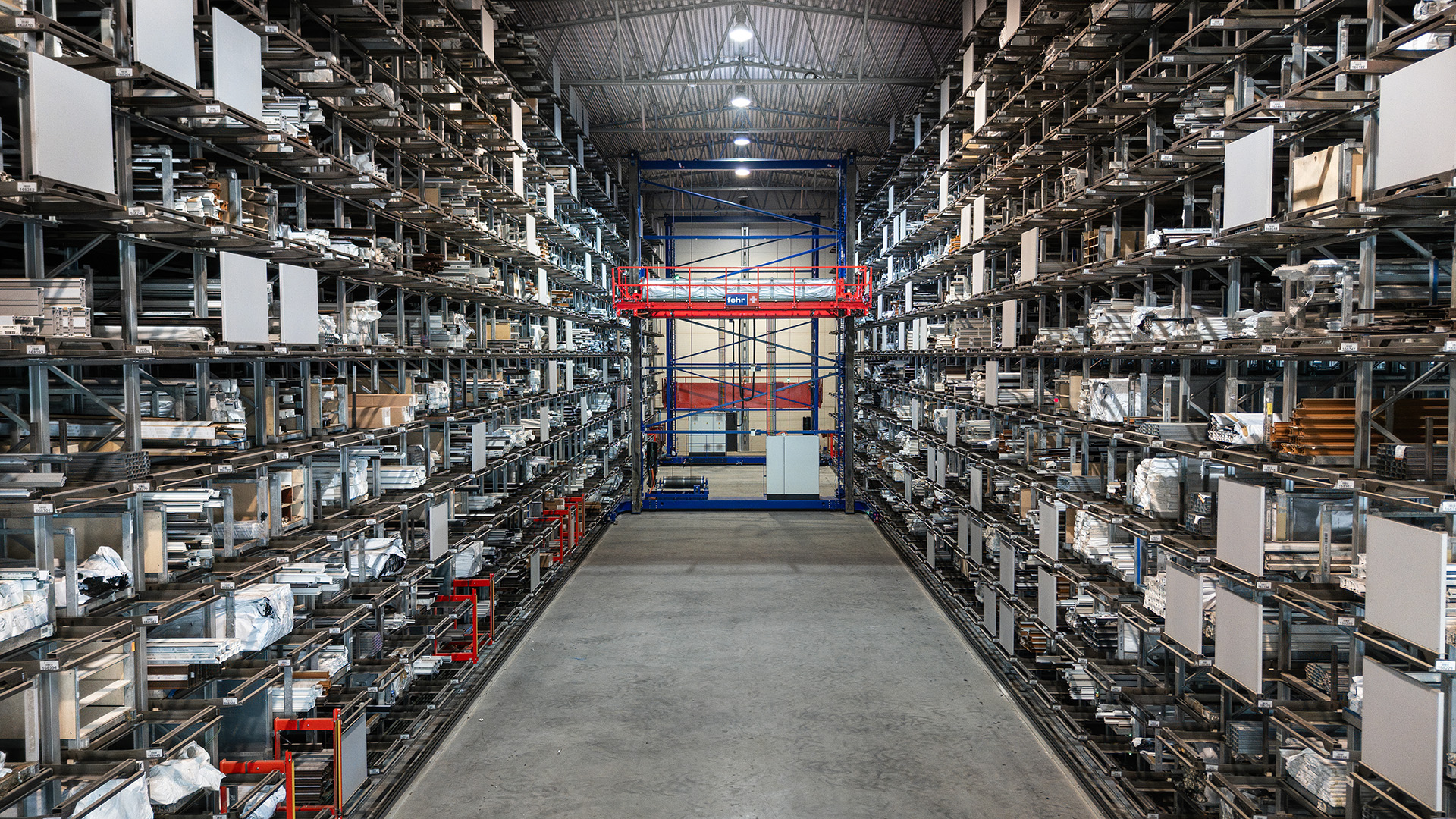
Abakus Okna had outgrown its automated warehouse—but had no room to expand it. The solution: a six-week retrofit that transformed the existing system, tripled logistics throughput, and opened the door to just-in-time production supply.

Project overview
- Location: Podlaskie voivodeship | Automated profile warehouse
- Production: 40,000 m² | 500+ employees
- Annual output: Approx. 500,000 window units | 1,000 storage positions
- Integration of processes in the new production hall
- Implementation: Six-week retrofit
- Results: 3× current throughput | Three shifts reduced to two
A Production Facility Where Logistics Sets the Pace
The automated warehouse at Abakus Okna’s production facility in Białystok area, Poland, is a central component of the company’s manufacturing process. Across approximately 40,000 m² of production space, more than 500 employees manufacture around 500,000 window units every year.
Abakus Okna has been active in the PVC and aluminum window and door industry for more than 30 years and serves demanding markets with premium products. At this scale, reliable material supply is essential: profiles must reach cutting and machining operations at the right time and in the right sequence to maintain continuous production.
The existing automated warehouse had been installed seven years earlier and remained mechanically sound. However, increasing production volumes had pushed the system beyond its original performance requirements.
The decision to modernize our key warehouse system was a natural step in Abakus Okna’s strategy of dynamic growth. As a premium window and door manufacturer, we cannot afford downtime or reactive logistics. We were looking for a solution that would not only remove the current constraints, but also provide a platform for continued expansion.
Marek Porzecki, CEO, Abakus Okna
Logistics Supporting Production Growth
Three challenges had become increasingly apparent.
- First, the existing logistics process required a three-shift operation. The night shift was used primarily to pick and stage profiles in advance so that daytime production could operate without interruption.
- Second, the solution used for intralogistics automation, based on an automated warehouse from another manufacturer, did not provide the operational efficiency required to handle growing production volumes.
- Third, the warehouse was located in the center of the production facility, leaving no practical option to expand the existing storage structure without taking valuable production space away from manufacturing.
With a new production hall planned, Abakus needed a solution that would increase warehouse performance, connect the existing and new production areas, and create additional capacity—without requiring a completely new warehouse.
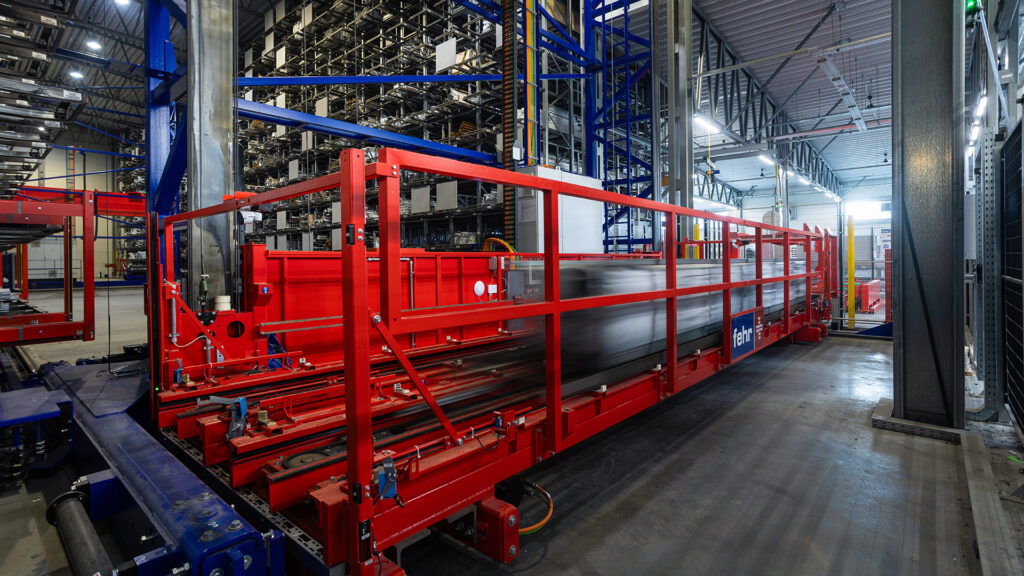
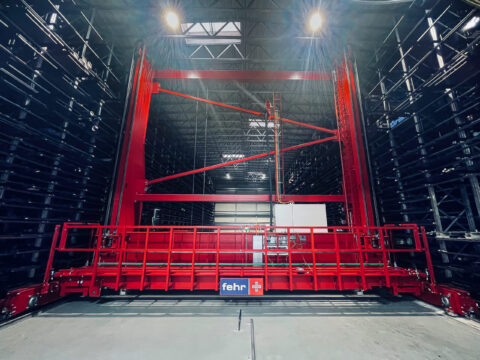
Automatic loading of profiles onto a rack stacker.
Retrofit Instead of Rebuild
The project presented a particular engineering challenge: Fehr was modernizing an existing automated warehouse that had not originally been built by Fehr.
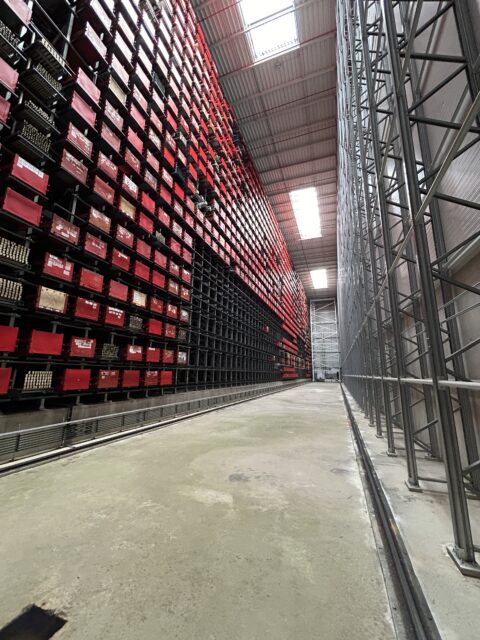
The retrofit strategy focused on retaining the existing steel rack structure with approximately 1,000 storage positions while replacing the technology that had become the limiting factor.
This enabled Abakus to make use of its existing infrastructure while significantly increasing the performance and flexibility of the warehouse system.
Implemented solutions have improved the efficiency of intralogistics, creating a scalable system that responds to current production needs and provides the necessary capacity reserve for the company’s future growth.
At the same time, Fehr completely replaced the PLC control system, electrical installation, and warehouse management and control software. The new control architecture provides the basis for more efficient coordination of storage, retrieval, and material movements.
The automated storage and retrieval system (ASRS) was therefore fundamentally modernized without replacing the warehouse’s existing rack structure.
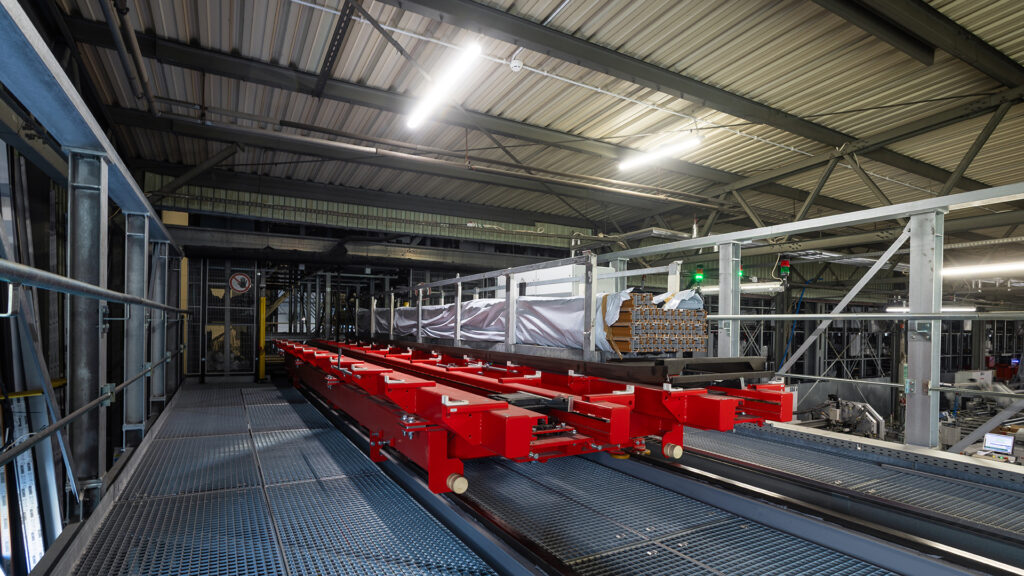
Automatic transport of profiles between the high-bay warehouse and the production hall takes place on a production bridge above the work area.
Connecting the Existing Warehouse to the New Production Hall
The planned expansion created another logistical challenge: the new production hall needed to be connected to the existing warehouse without sacrificing valuable manufacturing floor space.
Fehr implemented an elevated transport solution for profile carriers at a height of approximately 2.5 meters. Material can therefore move between the warehouse and production above the working area, keeping the floor available for production equipment and other processes.
This approach allowed Abakus to integrate the new production area into its existing logistics infrastructure without requiring a major expansion of the warehouse footprint.
Six Weeks of Precision Planning and Execution
Because the warehouse supplies material directly to production, a prolonged shutdown was not an option.
The retrofit therefore required precise coordination of dismantling, mechanical installation, electrical work, controls, software implementation, and commissioning.
Fehr completed the dismantling of the existing equipment, installation of the new stacker cranes, replacement of the control and electrical systems, and commissioning of the software within six weeks.
The timing of the project was also deliberately selected around the turn of the year, when seasonal demand in the construction industry is typically lower. This helped minimize the impact of the retrofit on production and customer deliveries.
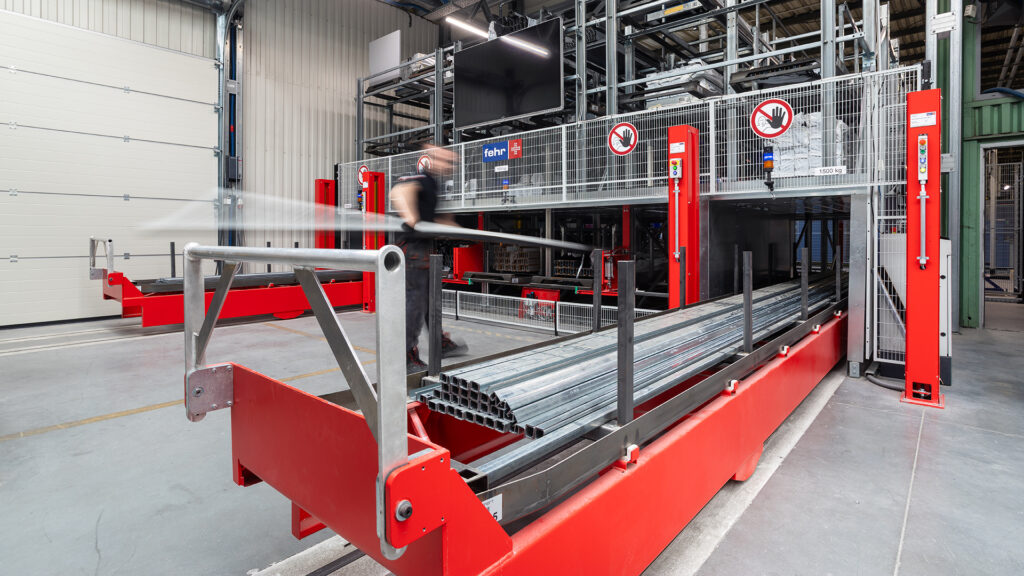
A buffer warehouse forming the final stage of an automated intralogistics system.
From Advance Staging to Just-in-Time Logistics
The most significant operational change goes beyond the increase in equipment performance.
Before the retrofit, Abakus relied on advance staging to ensure that production had sufficient material available during the day. The upgraded system enables the company to move toward a just-in-time logistics model, in which profiles are delivered to cutting machines and machining centers according to actual production requirements.
This reduces unnecessary staging and internal transportation while allowing logistics to respond more directly to production demand.
The result is a more flexible material flow with less labor tied up in pre-staging activities.
Higher Throughput, Fewer Shifts
The upgraded system is already operating at three times the throughput of the previous configuration.
At the same time, the logistics operation has been reduced from three shifts to two. Eliminating the night shift dedicated primarily to advance staging allows employees to be redeployed to processes with greater added value.
The effects of the implementation were visible almost immediately. The solution provided by Fehr met our expectations. Today our logistics processes are three times more efficient than before the modernisation.
Marek Porzecki, CEO, Abakus Okna
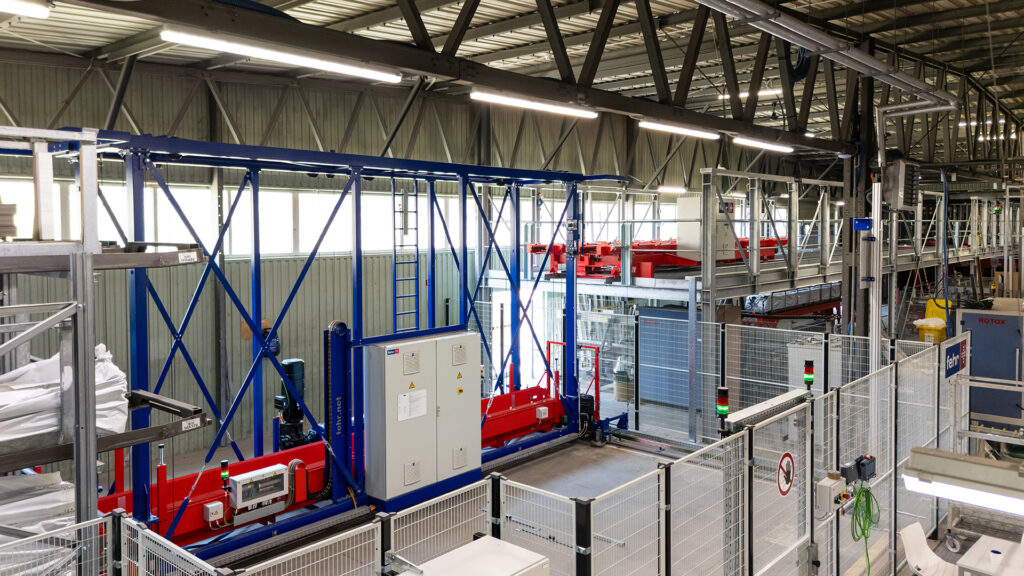
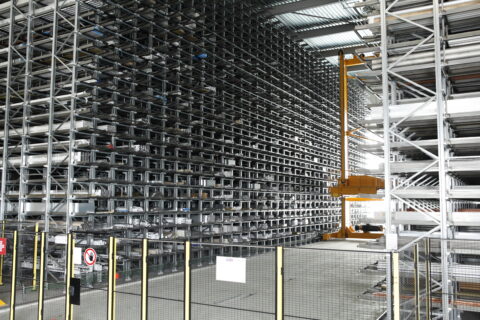
A small Fehr rack-based storage and retrieval machine serving the buffer store next to the production hall.
Supporting Consistent Product Quality
The logistics system also supports Abakus’s quality requirements.
The profiles used to manufacture the company’s windows are stored within the controlled environment of the production facility. Maintaining stable conditions helps ensure that the profiles reach the cutting and machining processes with consistent physical properties.
For premium window products, this consistency supports dimensional accuracy, precise machining, and the quality of finished joints.
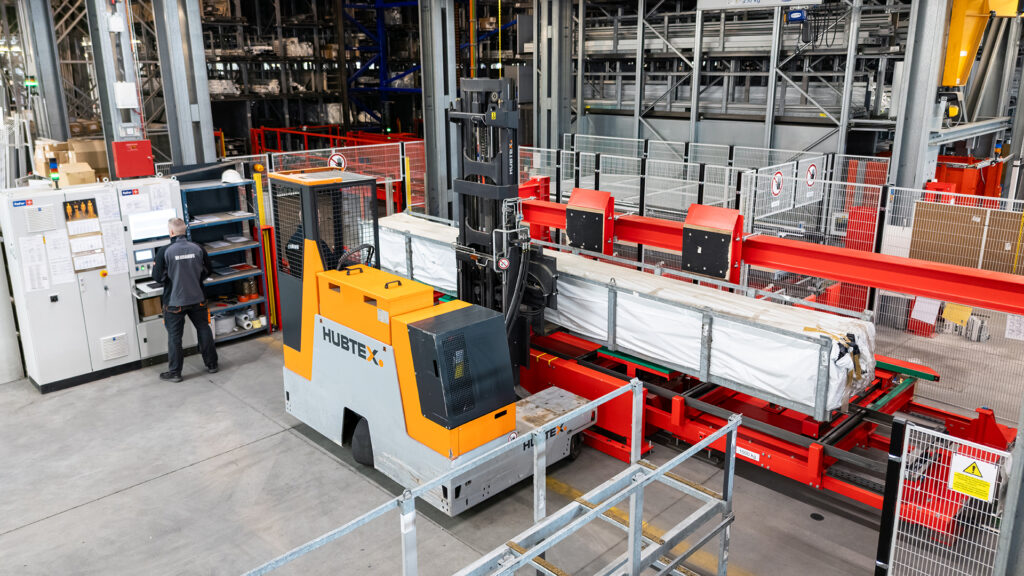
A Fehr carousel station integrated with a high-bay warehouse, designed for the automated handling of profile flow.
A Platform for Continued Growth
For Abakus, the retrofit was not simply a response to an existing limitation. It created a logistics platform capable of supporting the company’s continued growth.
By retaining the existing rack structure and selectively upgrading the automation, controls, electrical systems, and software, Abakus was able to significantly increase warehouse performance without the cost and disruption of building an entirely new warehouse.
The project demonstrates the potential of retrofit strategies in production-critical environments: when existing infrastructure remains viable, targeted modernization can unlock additional capacity while extending the value of the original investment.
For Abakus Okna, the result is a more responsive, higher-performance logistics operation that supports just-in-time material supply today while providing the capacity required for future expansion.
About Abakus Okna
Abakus Okna is a Polish manufacturer of PVC and aluminum windows and doors with more than 30 years of industry experience. Based in Choroszcz, Poland, the company operates a production facility covering approximately 40,000 m² and employs more than 500 people. Abakus Okna manufactures around 500,000 window units annually and serves customers in international markets. The company focuses on premium-quality window and door solutions, combining automated manufacturing processes with high standards for precision, product quality, and production efficiency.

Pawel Zielinski Sales & Project Management, Fehr Polska
Do you have questions? I look forward to your inquiry and will be happy to help you further.