
Supply chains have become more fragile, making production processes more complex and skilled workers harder to find. Automated warehouse solutions thus become central components of modern supply chain strategies. This is where Fehr comes in.
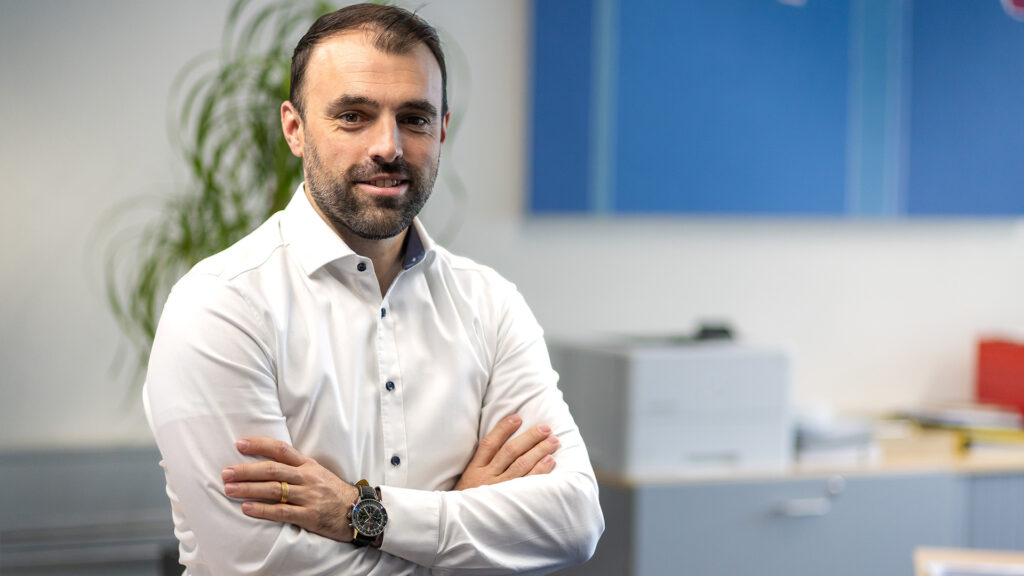
In a discussion with the Business Forum on 23.02.2026, Fehr CEO Thomas Lehner, who has been working in the company since 2012, explained how our family business has developed internationally, what role AI plays and why stable European framework conditions are crucial.
Business Forum: Mr. Lehner, how has the company developed – and what role do you play?
Thomas Lehner: Our roots go back to 1949, in today’s structure the company has existed since 2001. We are a second generation family business. I have been in the company since 2012, have gone through almost all areas and initially worked as a co-CEO for three years. For a year and a half, I have been the sole Managing Director and, together with the Executive Board, I am responsible for engineering/development, sales, finance, service/support and mechanical production.
Business Forum: How is the Fehr Group positioned today?
Thomas Lehner: Under the umbrella of Fehr Group AG, we employ around 260 people worldwide. About 80 of them work at the headquarters in Winterthur, where engineering and development are located. In Germany, there are 60 employees. In Italy – since 2024 together with its sister company Matter at two locations – there are around 90. In the US, the group employs about 20 people, supplemented by smaller units in France and Poland. Its annual turnover is around €120 million.
Business Forum: What is your core business?
Thomas Lehner: Turnkey storage and handling systems for heavy, bulky industrial goods – especially in the non-standardized sector. Our focus is on flat products such as sheets, doors or windows as well as long products such as steel, wood or aluminum profiles. The storage and handling of these goods is technically demanding and difficult to automate – that is where our specialization lies.
Business Forum: Which industries does Fehr work for?
Thomas Lehner: For production and trading companies in the metal, wood and plastics industries. We place a special focus on steel mills and steel service centers, as well as window builders, profile manufacturers and extrusion plants.
Business Forum: How is Fehr positioned in the market?
Thomas Lehner: We see ourselves as a specialized provider of complex material flow solutions for flat and long goods. Our focus is deliberately on non-standardized applications where technical depth, system integration and project experience are crucial. Instead of individual components, we supply holistic systems and support our customers throughout the entire life cycle of their plant. This means that we do not position ourselves as a pure product provider, but as a long-term system partner for demanding industrial applications.
Business Forum: What distinguishes Fehr from competition?
Thomas Lehner: As a traditional Swiss family-owned company, we cultivate long-term, trusting partnerships and invest heavily in development, service and continuous support throughout the entire life cycle. Our aim is to realize solutions that set new standards and convince people on a permanent basis. The differences often take many years to show – in longevity, stability and a predictable return on investment.
Business Forum: What perspectives do automation and AI open up in intralogistics?
Thomas Lehner: Automated, robot-supported systems are increasingly taking on manual, physically demanding tasks in production and logistics and thus helping to overcome the shortage of skilled workers. At the same time, they increase process reliability, increase throughput and reduce sources of error. In this way, material flows can be controlled more efficiently and supply chains made more stable. For us, it is crucial to examine carefully where artificial intelligence actually brings benefits. In the long goods sector, for example, where the technical implementation is particularly demanding, we combine robotics with AI-supported camera systems and integrate these solutions directly into systems such as saws or laser systems. This allows processes that have previously been carried out exclusively manually to be automated. This will significantly reduce the operational burden on companies.
For companies, however, digitalization and automation always mean change. Investments are long-term, existing structures need to be integrated and processes need to be adapted. That is why we rely on solutions that can be gradually expanded and integrated into existing processes in a controlled manner.

State-of-the-art robotics from Fehr Lagerlogistik AG automates the material flow from the high-bay warehouse to the production line at the steel dealer stürmsfs AG.
Business Forum: How have crises and global developments affected your company?
Thomas Lehner: For a long time, warehousing was considered a necessary evil. Stocks should be kept to a minimum in order to protect liquidity and avoid capital tie-ups. This paradigm has changed fundamentally in recent years. The pandemic acted like an accelerator in our industry. Interrupted supply chains have exposed to many companies how vulnerable globally optimized structures can be. Resilience today for our customers means cushioning production losses through their own storage capacities. In order to secure their production and to be able to serve end customers reliably, many are therefore increasingly relying on decentralized storage solutions. For us, this means a structural shift in demand. The trend towards greater storage autonomy leads companies to invest specifically in modern storage systems. Thanks to our international position – including new locations in France, Italy and Poland – we are able to react flexibly to these developments and to support our customers in different markets.

Maximum space utilization, minimum travel times: The automated honeycomb warehouse stands for precision, efficiency and intelligent material flows
Business Forum: How do sustainability and political developments influence your international strategy?
Thomas Lehner: Sustainability is part of our strategy, especially with regard to regional value creation. We want to produce as close as possible to our customers and design supply chains in such a way that they remain efficient and well-planned. At the same time, we see that changing customs and trade conditions sometimes make these objectives more difficult. However, we try to separate politics and corporate strategy as much as possible. We cannot and will not respond to short-term political fluctuations; our orientation is long-term. Of course, we are closely monitoring global developments. Europe and the US remain important core markets for us. However, an economically strong and reliable Europe with stable framework conditions would be desirable, as it strengthens the basis for sustainable growth for us and our customers. At the same time, we are specifically examining new markets. We see potential in Asia, including India and China.
In an interview:
Thomas Lehner, Managing Director
Fehr Lagerlogistik AG
In der Au 5
8406 Winterthur
Switzerland
thomas.lehner@fehr.net
+41 52 2605687